If you are applying to an English-taught degree at an Italian university, there is a good chance you will meet the CEnT-S. This guide covers what the test is, how it is structured and how it is scored, so you know exactly what you are preparing for.
What is the CEnT-S?
The CEnT-S is the English-language admission test run by CISIA, the consortium of Italian universities behind the TOLC tests. Many Italian universities use it to admit students to English-taught degree programmes.
You can take it in two ways:
- @UNI: at a university, in a test room.
- @HOME: online, from your own home.
The six sections
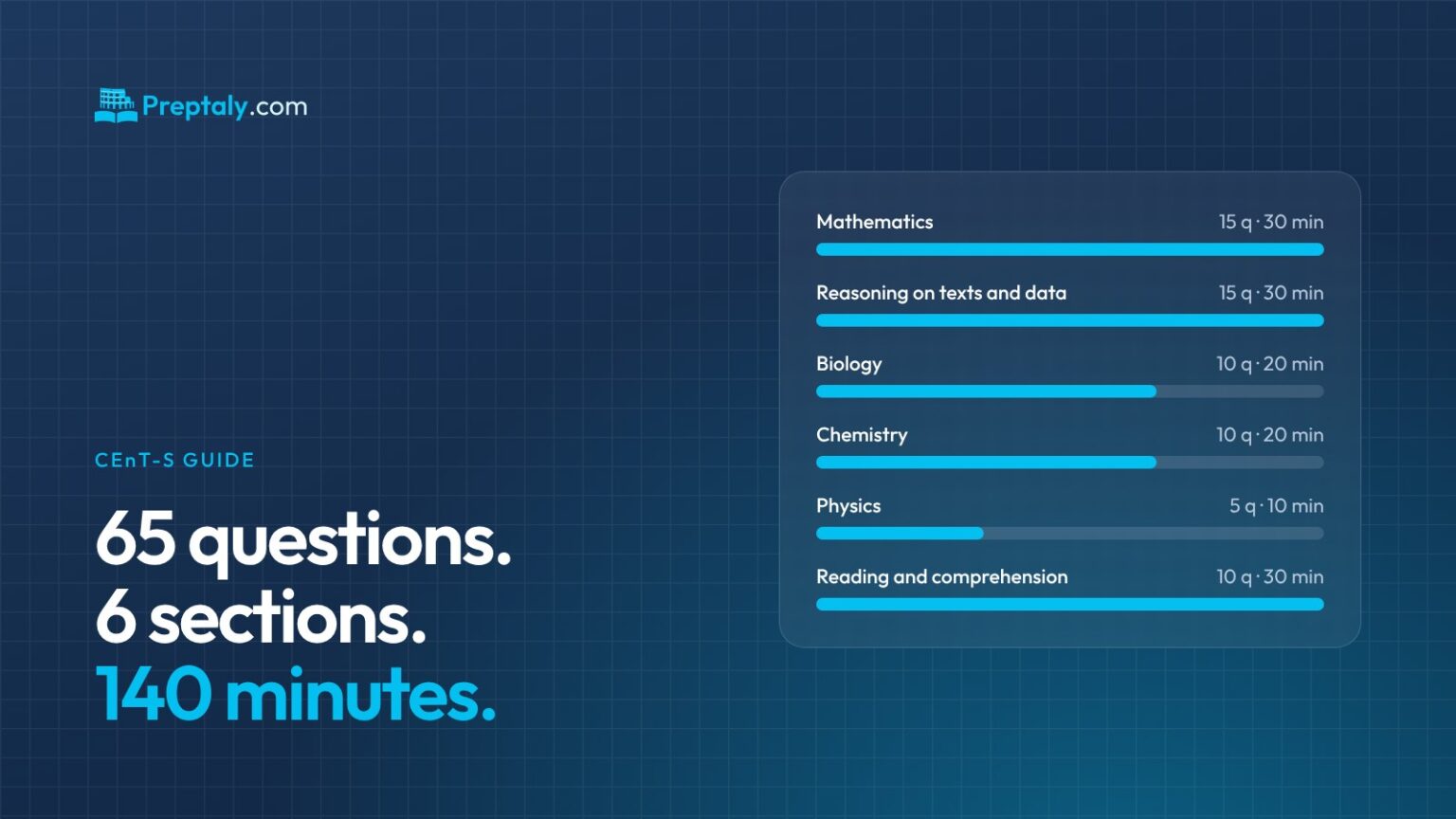
The test has 65 multiple-choice questions split into six sections. Each section has its own timer, and you take them in a fixed order.
| Section | Questions | Time |
|---|---|---|
| Mathematics | 15 | 30 minutes |
| Reasoning on texts and data | 15 | 30 minutes |
| Biology | 10 | 20 minutes |
| Chemistry | 10 | 20 minutes |
| Physics | 5 | 10 minutes |
| Reading and comprehension | 10 | 30 minutes |
| Total | 65 | 140 minutes |
Because every section is timed separately, you can’t carry minutes over. Finishing Mathematics early does not buy you extra time in Physics.
How the CEnT-S is scored
- Correct answer: +1 point
- Unanswered question: 0 points
- Wrong answer: −0.25 points
The highest possible raw score is 65. At the end of each test period, CISIA normalises the scores to take the difficulty of the test into account, so your final result is not simply your raw total.
What the penalty means for guessing
Each question has five options. A completely blind guess is right one time in five, so on average it earns nothing: the point you gain when you are lucky is cancelled out by the −0.25 you lose on the other four. Once you can rule out even one option, the odds tip in your favour, and choosing between the remaining answers is worth it on average.
How to prepare
Knowing the structure is the first step. The second is getting used to it under real conditions: the section order, the timers and the scoring. That is what a full mock test in the real interface is for.
Try the free CEnT-S demo test to see the interface for yourself.